

The TOGAF® EA Framework for Sustaining Enterprise AI Adoption


November 11, 2026

Aaron Tan Dani
By Aaron Tan Dani, Group Chief Enterprise Architect, ATD Solution
Most AI programmes are judged at launch. The harder test comes eighteen months later, when the model has drifted, the regulations have moved, a better Large Language Model (LLM) has arrived and the business process around the agent has changed. Gartner predicts that over 40% of agentic AI projects will be cancelled by the end of 2027 because of escalating costs, unclear business value or inadequate risk controls. Look closely at those three causes. None is a failure to build. All are failures to sustain.
Sustaining AI is an architecture problem, and the TOGAF® EA Standard 10th Edition, remains the most complete method I know for solving it.
It begins by connecting the Architecture Development Method (ADM) to the layers of the enterprise, modelled in ArchiMate®. Strategy and motivation sit at the top, then business, application, technology and implementation layers, with information and data running through all of them. Each layer carries its own AI concerns:
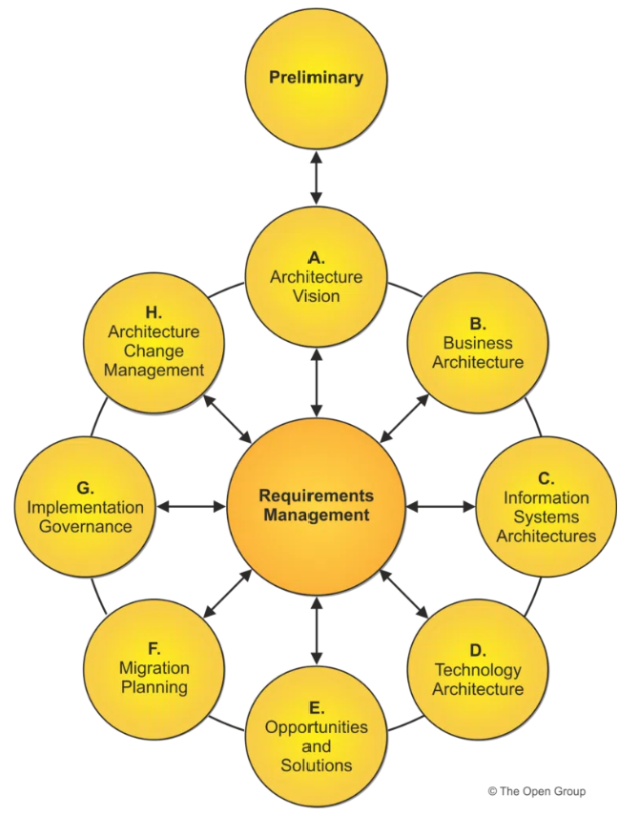
The Architecture Development Method (ADM) is the core process of the TOGAF® framework, providing a structured yet adaptable approach to developing, maintaining, and governing Enterprise Architecture over time. Organised as an iterative cycle of phases, the ADM guides organisations from defining an architecture vision to implementing solutions and managing change, ensuring that architecture activities remain systematic, repeatable, and aligned with business goals. Rather than following a rigid sequence, organisations can tailor the ADM to their specific needs, applying selected phases or revisiting the cycle based on the scope and maturity of their architecture practice.
The ADM runs through four iterations: architecture capability, architecture development, transition planning and architecture governance. Applied to AI, each phase has a clear job.
Preliminary and Phase A (Architecture Vision): Establish an AI Governance Board, identify stakeholders from business and IT, and record their concerns for each use case. Define AI goals and success metrics such as cost reduction, efficiency gains or revenue impact, then align the AI strategy with enterprise objectives and agree AI and BDAT (Business, Data, Application, Technology) principles.
Phase B (Business Architecture) to Phase D (Technology Architecture): Look for gaps in business processes, data and applications, and infrastructure, and develop the target architecture for each domain. We treat the four domains as one conversation, each with a distinct role:
Each domain produces concrete deliverables, from a use case portfolio and data classification to AI solution patterns and a security baseline. These become the reusable foundation that keeps each new agent from adding to architectural debt.
Phase E (Opportunities and Solutions) and Phase F (Migration Planning): Consolidate gaps across all use cases, validate model performance against business KPIs, classify solutions into portfolios and projects, and plan change management for deployment across departments.
Phase G (Implementation Governance) and Phase H (Architecture Change Management): This is where sustainability is earned. Phase G defines AI risk policies, implements ethics guidelines aligned with the TOGAF® risk approach, monitors agents for fairness, accuracy and regulatory compliance, and puts machine learning operations in place for continuous model improvement. Phase H manages change over time: updating models, retraining agents as technology advances, monitoring ethics and privacy compliance, and tracking AI performance through measures such as resolution rates and user feedback.
Because the ADM is iterative, what Phase H learns feeds the next Phase A. That loop is the engine of sustained adoption. It also complements external frameworks. The National Institute of Standards and Technology (NIST) AI Risk Management Framework organises AI risk work around govern, map, measure and manage, and the International Organisation for Standardisation and International Electrotechnical Commission (ISO/IEC) 42001 sets out requirements for an AI management system. TOGAF® gives these an architectural home.
To keep this practical, we package five building blocks (AI strategy, organisation, governance, data and technology) into three delivery phases:
We measure success against six outcomes: aligned AI ambitions, AI policy and governance, AI ownership and culture, an augmented workforce, a healthy AI technology environment and a mapped AI landscape with demonstrable return on investment. Notice that “healthy architecture debt” and “ROI for AI investment” are on that list. They are the signs that AI is being run as a capability rather than a campaign.
You do not need to run every phase at full depth on day one. Start with a governance board and a small set of use cases, close the gaps through Phases A to D, and put Phase G and H disciplines in place before the first agent goes live. Sustainable AI adoption is designed, not hoped for.
Sustaining AI takes more than good models. It takes a foundation that aligns, integrates and governs every initiative. That is how ATD Solution applies Enterprise Architecture to business, digital and AI transformation. To explore how it could work for you, discuss your requirements and speak to our speacialist.
Most AI programmes are judged at launch. The harder test comes eighteen months later, when the model has drifted, the regulations have moved, a better Large Language Model (LLM) has arrived and the business process around the agent has changed. Gartner predicts that over 40% of agentic AI projects will be cancelled by the end of 2027 because of escalating costs, unclear business value or inadequate risk controls. Look closely at those three causes. None is a failure to build. All are failures to sustain.
Sustaining AI is an architecture problem, and the TOGAF® EA Standard 10th Edition, remains the most complete method I know for solving it.
A connected architecture, not a collection of projects
It begins by connecting the Architecture Development Method (ADM) to the layers of the enterprise, modelled in ArchiMate®. Strategy and motivation sit at the top, then business, application, technology and implementation layers, with information and data running through all of them. Each layer carries its own AI concerns:
- Strategy and motivation: AI goals, strategies, capabilities and use cases.
- Business: AI capabilities, change management, business gaps and information gaps.
- Application: AI agents, tools and workflows, plus data and application gaps.
- Technology: AI infrastructure, security gaps and technology gaps.
- Implementation: the AI roadmap, deployment and agile development.
Walking the ADM with an AI lens
The Architecture Development Method (ADM) is the core process of the TOGAF® framework, providing a structured yet adaptable approach to developing, maintaining, and governing Enterprise Architecture over time. Organised as an iterative cycle of phases, the ADM guides organisations from defining an architecture vision to implementing solutions and managing change, ensuring that architecture activities remain systematic, repeatable, and aligned with business goals. Rather than following a rigid sequence, organisations can tailor the ADM to their specific needs, applying selected phases or revisiting the cycle based on the scope and maturity of their architecture practice.
The ADM runs through four iterations: architecture capability, architecture development, transition planning and architecture governance. Applied to AI, each phase has a clear job.
Preliminary and Phase A (Architecture Vision): Establish an AI Governance Board, identify stakeholders from business and IT, and record their concerns for each use case. Define AI goals and success metrics such as cost reduction, efficiency gains or revenue impact, then align the AI strategy with enterprise objectives and agree AI and BDAT (Business, Data, Application, Technology) principles.
Phase B (Business Architecture) to Phase D (Technology Architecture): Look for gaps in business processes, data and applications, and infrastructure, and develop the target architecture for each domain. We treat the four domains as one conversation, each with a distinct role:
- Business Architecture ensures AI aligns to outcomes, defines decision boundaries (augment versus automate) and clarifies business ownership.
- Data Architecture exposes the reality of data readiness, identifies authoritative data domains and sets governance constraints for AI execution.
- Application Architecture sets boundaries for AI solutions through solution patterns, integration points, build-versus-buy decisions and non-functional requirements such as latency, explainability and auditability.
- Technology Architecture enables safe experimentation and production-grade operations through secured environments, access controls, approved GenAI and MLOps platforms, and identity, logging and monitoring.
Each domain produces concrete deliverables, from a use case portfolio and data classification to AI solution patterns and a security baseline. These become the reusable foundation that keeps each new agent from adding to architectural debt.
Phase E (Opportunities and Solutions) and Phase F (Migration Planning): Consolidate gaps across all use cases, validate model performance against business KPIs, classify solutions into portfolios and projects, and plan change management for deployment across departments.
Phase G (Implementation Governance) and Phase H (Architecture Change Management): This is where sustainability is earned. Phase G defines AI risk policies, implements ethics guidelines aligned with the TOGAF® risk approach, monitors agents for fairness, accuracy and regulatory compliance, and puts machine learning operations in place for continuous model improvement. Phase H manages change over time: updating models, retraining agents as technology advances, monitoring ethics and privacy compliance, and tracking AI performance through measures such as resolution rates and user feedback.
Because the ADM is iterative, what Phase H learns feeds the next Phase A. That loop is the engine of sustained adoption. It also complements external frameworks. The National Institute of Standards and Technology (NIST) AI Risk Management Framework organises AI risk work around govern, map, measure and manage, and the International Organisation for Standardisation and International Electrotechnical Commission (ISO/IEC) 42001 sets out requirements for an AI management system. TOGAF® gives these an architectural home.
From method to delivery
To keep this practical, we package five building blocks (AI strategy, organisation, governance, data and technology) into three delivery phases:
- AI Direction and Guardrails: align stakeholders, set guardrails and establish governance and data readiness. The outcome is an AI-ready, strategically aligned and architecturally bounded organisation.
- AI Architecture and Build: prioritise the portfolio, build the operating model and reference architecture, and raise AI literacy. The outcome is agents delivering value with architectural consistency and governance.
- AI Operations and Monitoring: deploy agents, operate enterprise models and scale architecture, governance and workforce. The outcome is agents that are trusted, governed and scalable.
What sustained adoption looks like
We measure success against six outcomes: aligned AI ambitions, AI policy and governance, AI ownership and culture, an augmented workforce, a healthy AI technology environment and a mapped AI landscape with demonstrable return on investment. Notice that “healthy architecture debt” and “ROI for AI investment” are on that list. They are the signs that AI is being run as a capability rather than a campaign.
You do not need to run every phase at full depth on day one. Start with a governance board and a small set of use cases, close the gaps through Phases A to D, and put Phase G and H disciplines in place before the first agent goes live. Sustainable AI adoption is designed, not hoped for.
Sustaining AI takes more than good models. It takes a foundation that aligns, integrates and governs every initiative. That is how ATD Solution applies Enterprise Architecture to business, digital and AI transformation. To explore how it could work for you, discuss your requirements and speak to our speacialist.