

IASA BTABoK Business and Solution Architecture Practitioner
- Course Overview
- Programme Outline
- Course Fees and Fundings
This programme prepares mid-career professionals to transition into Business Architect and Solution Architect roles by developing the ability to align business strategy with technology execution.
Participants will learn how to translate business needs into architectural strategies, design enterprise and solution architectures, and govern implementation across systems and stakeholders. The programme integrates enterprise architecture frameworks, business technology strategy, and solution design practices, anchored on real-world application.
Through applied learning, case studies, and architecture-based problem-solving exercises, participants will develop practical capabilities in architecture thinking, roadmap development, solution design, and governance within enterprise environments.
The curriculum is aligned with the Skills Framework for Information and Communications Technology (ICT) and industry-recognised International Association of Software Architects (IASA) competencies, ensuring relevance to current enterprise architecture practices.
IASA Global, BTABoK stands for the Business Technology Architecture Body of Knowledge.
It is a comprehensive professional framework and living body of knowledge designed to teach, guide, and certify business and technology architects. Originally known as the ITABoK (Information Technology Architecture Body of Knowledge), it was renamed to reflect a stronger focus on bridging the gap between technical skills and measurable business value.
The SkillsFuture Career Transition Programme (SCTP) supports mid-career individuals in acquiring industry-relevant skills to improve employability and pivot to new sectors or job roles. It is a train-and-place programme that is available in a part-time or full-time format, ranging from three to 12 months.
Similar to existing requirements for other training grants administered by SSG, trainees must fulfil minimum attendance requirements and pass the assessments to qualify for course fee subsidies. Trainees who are unable to meet these requirements, or exit the programme without a valid reason, may be asked to return the course fee subsidy that they have received, including any additional course fee funding support. Under the SCTP scheme, trainees are encouraged to complete all modules to fully benefit from the intent of the programme.
For more information, please refer to the FAQs on SCTP or the SkillsFuture website.
Recommended For
This programme is suitable for professionals looking to transition into Business Architect or Solution Architect roles, particularly those already operating at the intersection of business and technology.
The programme is relevant for roles:
- Business Analysts / Senior Business Analysts
- Systems Analysts / Functional Analysts
- Solution Designers / Technical Leads
- Enterprise / Information Technology (IT) Project Managers
- Product Managers (with strong tech exposure)
- IT Consultants (business or technology domain)
- Software Engineers / Developers moving into design roles
- Data Analysts / Data Engineers with business exposure
- Infrastructure / Cloud Engineers moving towards architecture
- Cybersecurity professionals expanding into enterprise design
- Business Transformation / Strategy professionals
- Operations leads involved in digital transformation
(Must have exposure to IT systems and processes)
Course Duration: 25 Days (part-time over 6 months)
Entry Requirements:
Learners should be able to:
- Read, write and speak English at Workforce Skills Qualification (WSQ) Workplace Literacy (WPL) Level 6
- Communicate effectively and able to engage in classroom
- Basic Information Technology (IT) knowledge (and powerpoint skills)
Programme Outline
By the end of the programme, participants will have a good understanding of:
Strategy and Alignment
- Translate business goals into technology strategies and architecture roadmaps
- Define architecture principles, standards, and governance structures
- Align stakeholders across business and Information Technology (IT) functions
Architecture Design (Business + Solution)
- Develop business architecture models (capabilities, value streams, operating models)
- Design end-to-end solution architectures across applications, data, and infrastructure
- Evaluate architecture options based on trade-offs (cost, risk, scalability, performance)
Execution and Governance
- Drive solution architecture implementation across project lifecycles
- Establish architecture governance, review processes, and quality assurance
- Ensure alignment between enterprise architecture and delivery teams
Analysis and Continuous Improvement
- Conduct business needs analysis and translate into architecture requirements
- Assess current-state vs target-state architectures and define transition roadmaps
- Monitor architecture performance and drive continuous improvement
Emerging Technology and Innovation
- Evaluate emerging technologies and their impact on enterprise architecture
- Incorporate innovation into architecture planning and solution design
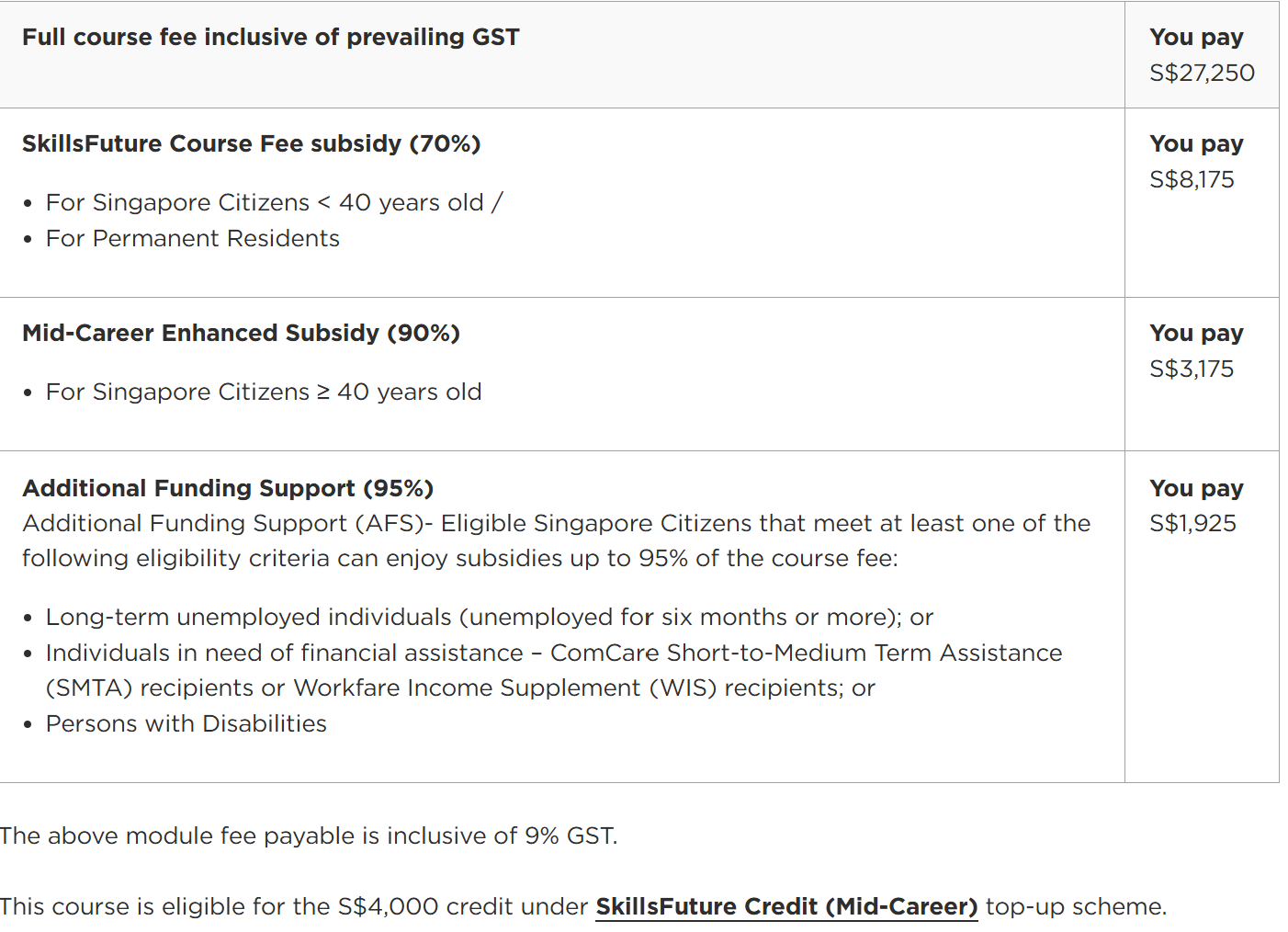
Course Fees and Fundings