


The Iasa IBAM™ Digital Advantage for Creating AI Portfolios


By Aaron Tan Dani, Group Chief Enterprise Architect, ATD Solution
Every executive I speak with has an AI backlog. Very few have an AI portfolio. The difference matters. Gartner predicts that over 40% of agentic AI projects will be cancelled by the end of 2027 because of escalating costs, unclear business value or inadequate risk controls. MIT’s NANDA initiative reported that about 95% of enterprise generative AI pilots showed no measurable profit-and-loss impact.
A backlog collects ideas. A portfolio makes choices, assigns owners and shows how the pieces fit together.
The most useful tool I have found for making that shift comes from the architecture profession itself: the IBAM™ model in the Iasa Business Technology Architecture Body of Knowledge (BTABoK™).
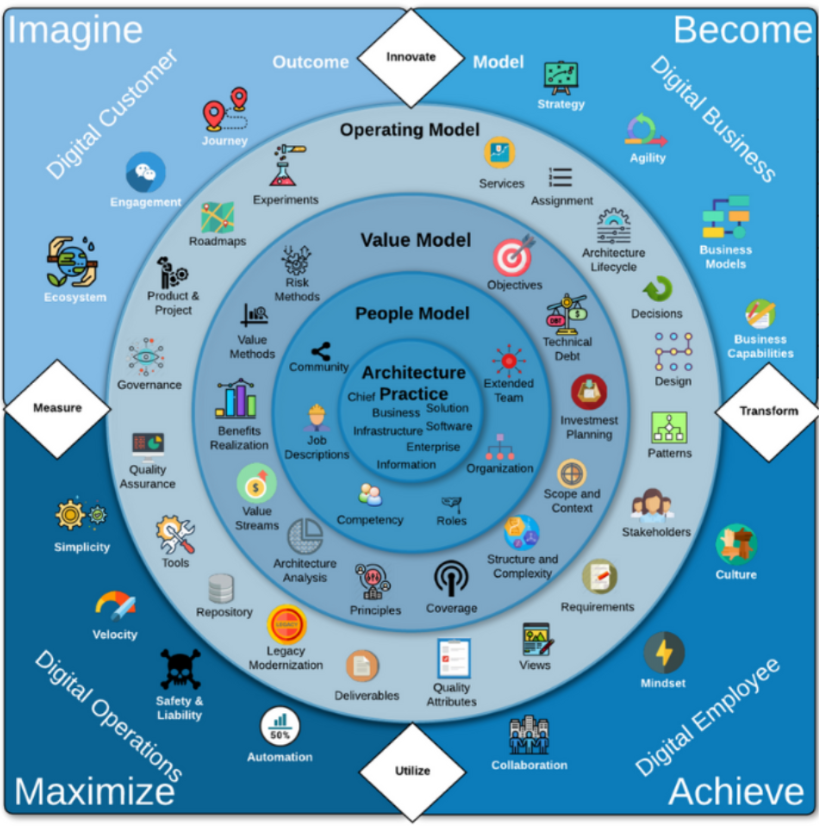
Iasa positions BTABoK around digital advantage, and IBAM can be used as an architecture principle for developing AI use cases. The name is a mnemonic for four corners of the model:
That structure is the real lesson for AI. A use case is never just a model. It touches who owns the outcome (People), what value it creates (Value) and how the organisation runs it (Operating). Use cases generated without those rings stall in pilot, which is exactly the pattern in the statistics above.
The first method I apply with IBAM is futurecasting. Step one is to collect signals from the future. These are the weak, early indicators that most organisations notice only after a competitor has acted: a new customer behaviour, a regulatory consultation, a start-up pattern, a capability becoming cheap. Collected deliberately and read across all four IBAM corners, signals widen the option space before any budget is committed.
The discipline is to ask each corner a different question of the same signal. A shift in customer expectations is an Imagine question. What it does to our service model is a Become question. What it means for our people is an Achieve question. What it demands of our platforms is a Maximize question. One signal can yield four connected use cases, which is how you start a portfolio rather than a pilot.
The second method is unbundling. The well-known CB Insights market map, Unbundling the Automobile, shows one product decomposed into dozens of specialist segments, including engine efficiency, sensor hardware, battery storage, connected car, driver safety, navigation, cybersecurity and auto repair, each populated by companies applying new technology. The automobile did not change in one move. It was taken apart, and each part was reinvented.
We apply the same thinking to the enterprise using the TOGAF® ADM building blocks. Architecture Building Blocks (ABBs) describe the capability required. Solution Building Blocks (SBBs) describe the products or components that realise it. Separating the two forces a useful question for every AI candidate: what capability do we need, and should we build, buy or partner to deliver it?
Here is the sequence I recommend:
Iasa treats the architect as a Profession with a capital P, spanning business, information, software, infrastructure and solution architects. Architects often innovate at the edges, where customer, business, workforce and operations meet. In AI, those edges are exactly where value is created and where risk hides.
If you are building your portfolio, ask yourself three questions. From which IBAM corners do our current AI ideas come? Who owns each outcome in the business? And which signals from the future are we still ignoring? Your answers will show whether you are managing a portfolio or a backlog.
At ATD Solution, we help organisations turn AI ideas into a governed portfolio. By pairing business, digital and AI transformation with Enterprise Architecture, we align strategy, integrate investments and capabilities, and give you end-to-end roadmap visibility.
Whether you're exploring Enterprise Architecture consulting, corporate training, certification programmes or transformation initiatives, our specialists are here to help. Let's discuss your requirements and contact us now.
Every executive I speak with has an AI backlog. Very few have an AI portfolio. The difference matters. Gartner predicts that over 40% of agentic AI projects will be cancelled by the end of 2027 because of escalating costs, unclear business value or inadequate risk controls. MIT’s NANDA initiative reported that about 95% of enterprise generative AI pilots showed no measurable profit-and-loss impact.
A backlog collects ideas. A portfolio makes choices, assigns owners and shows how the pieces fit together.
The most useful tool I have found for making that shift comes from the architecture profession itself: the IBAM™ model in the Iasa Business Technology Architecture Body of Knowledge (BTABoK™).
One map for the whole enterprise
Iasa positions BTABoK around digital advantage, and IBAM can be used as an architecture principle for developing AI use cases. The name is a mnemonic for four corners of the model:
- Imagine – Digital Customers and Citizens: What will the people we serve expect, and where can AI improve their journey, engagement and ecosystem?
- Become – Digital Business or Government: How must our strategy, services, decisions and business capabilities change to deliver it?
- Achieve – Digital Employees (Human and AI): How will people and AI agents work together, and where do we augment versus automate?
- Maximize – Digital Operations (Continuous Integration/ Continuous Deployment): How do we run, automate, monitor and continuously improve AI in production?
That structure is the real lesson for AI. A use case is never just a model. It touches who owns the outcome (People), what value it creates (Value) and how the organisation runs it (Operating). Use cases generated without those rings stall in pilot, which is exactly the pattern in the statistics above.
Futurecasting: collecting signals from the future
The first method I apply with IBAM is futurecasting. Step one is to collect signals from the future. These are the weak, early indicators that most organisations notice only after a competitor has acted: a new customer behaviour, a regulatory consultation, a start-up pattern, a capability becoming cheap. Collected deliberately and read across all four IBAM corners, signals widen the option space before any budget is committed.
The discipline is to ask each corner a different question of the same signal. A shift in customer expectations is an Imagine question. What it does to our service model is a Become question. What it means for our people is an Achieve question. What it demands of our platforms is a Maximize question. One signal can yield four connected use cases, which is how you start a portfolio rather than a pilot.
Unbundling: seeing the organisation as building blocks
The second method is unbundling. The well-known CB Insights market map, Unbundling the Automobile, shows one product decomposed into dozens of specialist segments, including engine efficiency, sensor hardware, battery storage, connected car, driver safety, navigation, cybersecurity and auto repair, each populated by companies applying new technology. The automobile did not change in one move. It was taken apart, and each part was reinvented.
We apply the same thinking to the enterprise using the TOGAF® ADM building blocks. Architecture Building Blocks (ABBs) describe the capability required. Solution Building Blocks (SBBs) describe the products or components that realise it. Separating the two forces a useful question for every AI candidate: what capability do we need, and should we build, buy or partner to deliver it?
Turning use cases into a portfolio
Here is the sequence I recommend:
- Futurecast signals across all four IBAM corners.
- Unbundle the organisation into capabilities and building blocks.
- Generate candidate AI use cases from each corner, not only from Achieve, where tool-led productivity ideas tend to cluster.
- Score and sequence by value, risk and feasibility, including data readiness and architecture debt.
- Assign a business owner, success metrics and governance to each initiative, and make shared dependencies visible so platforms and data are built once.
Innovating at the edges
Iasa treats the architect as a Profession with a capital P, spanning business, information, software, infrastructure and solution architects. Architects often innovate at the edges, where customer, business, workforce and operations meet. In AI, those edges are exactly where value is created and where risk hides.
If you are building your portfolio, ask yourself three questions. From which IBAM corners do our current AI ideas come? Who owns each outcome in the business? And which signals from the future are we still ignoring? Your answers will show whether you are managing a portfolio or a backlog.
At ATD Solution, we help organisations turn AI ideas into a governed portfolio. By pairing business, digital and AI transformation with Enterprise Architecture, we align strategy, integrate investments and capabilities, and give you end-to-end roadmap visibility.
Whether you're exploring Enterprise Architecture consulting, corporate training, certification programmes or transformation initiatives, our specialists are here to help. Let's discuss your requirements and contact us now.