


Why Enterprise AI Initiatives Fail: The Transformation Gap


September 9, 2026

Alecia Heng, Chief Business Architect at ATD Solution
By Alecia Heng, Chief Business Architect at ATD Solution
Artificial intelligence has rapidly moved from experimentation to a boardroom priority. Organisations are investing in AI, launching pilots and exploring new use cases with the expectation of improving productivity, accelerating innovation and creating new business value.
Yet despite growing investment, many organisations are still struggling to turn AI initiatives into measurable enterprise outcomes.
Gartner expects that escalating costs, unclear business value and increasing risk will lead to the cancellation of 40% of agentic AI projects by the end of 2027. McKinsey research finds that while 92% of companies plan to increase their AI investments over the next three years, only 1% of business leaders describe their organisations as mature in AI deployment. The article also cites MIT research showing that despite significant enterprise investment in generative AI, only a small proportion of projects are delivering measurable returns.
The question is no longer whether organisations are investing in AI.
The bigger question is why so many AI initiatives struggle to translate investment into scalable and measurable business value.
The answer often lies not in the AI technology itself, but in a wider transformation gap between AI ambition and the organisation's ability to execute, govern and scale it across the enterprise.
Read also: Realistic AI: Beyond the Hype Cycle
Organisations are investing in AI, but most are not seeing tangible outcomes as expected:
Result: High investments, low impact, and risking risk without a structured approach to transformation.
The fundamental shift organisations need to make is from implementing individual AI projects to building an enterprise that is ready to adopt, govern and scale AI.
Instead of treating AI as a collection of isolated technology initiatives, organisations need to establish the enterprise capabilities required to support AI-driven transformation.
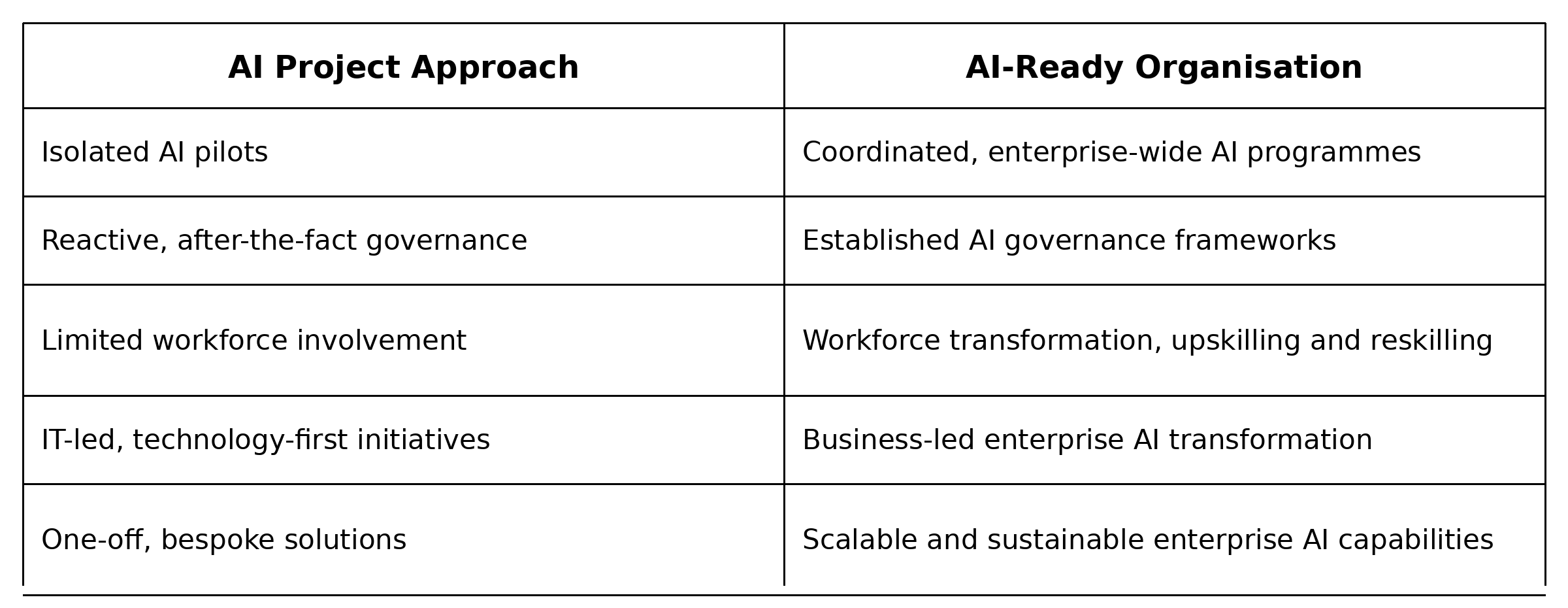
This transition is central to moving beyond experimentation and creating an organisation capable of scaling AI sustainably.
Ultimately, the challenge is not simply how to adopt more AI. It is how to transform the organisation so that AI can deliver sustainable business value.
Enterprise value comes when AI adoption is supported by:
This is where Business Architecture can play an important role.
Business Architecture provides a structured approach for connecting strategy, customer needs, business capabilities and transformation initiatives. When applied to AI-driven transformation, it helps organisations identify where AI can create meaningful value, determine which capabilities need to change and coordinate the initiatives required to move from ambition to execution.
Read also: Driving Successful Transformation with Business Architecture
Join Architecting AI-Driven Business Transformation Workshop and learn how to design an end-to-end AI-Driven transformation journey using a Business Architecture approach to connect customer needs, business capabilities, and AI technologies to deliver measurable outcomes.
Explore the Architecting AI-Driven Business Transformation Workshop
In this short video, Alecia Heng, Chief Business Architect at ATD Solution, explains the core challenges facing AI initiatives today and the industry best practices standard for EA & AI practices.
Read also: Architecting AI-Driven Business Transformation: From Readiness to Scalable Value
Artificial intelligence has rapidly moved from experimentation to a boardroom priority. Organisations are investing in AI, launching pilots and exploring new use cases with the expectation of improving productivity, accelerating innovation and creating new business value.
Yet despite growing investment, many organisations are still struggling to turn AI initiatives into measurable enterprise outcomes.
Gartner expects that escalating costs, unclear business value and increasing risk will lead to the cancellation of 40% of agentic AI projects by the end of 2027. McKinsey research finds that while 92% of companies plan to increase their AI investments over the next three years, only 1% of business leaders describe their organisations as mature in AI deployment. The article also cites MIT research showing that despite significant enterprise investment in generative AI, only a small proportion of projects are delivering measurable returns.
The question is no longer whether organisations are investing in AI.
The bigger question is why so many AI initiatives struggle to translate investment into scalable and measurable business value.
The answer often lies not in the AI technology itself, but in a wider transformation gap between AI ambition and the organisation's ability to execute, govern and scale it across the enterprise.
Read also: Realistic AI: Beyond the Hype Cycle
Why Most AI Initiatives Struggle Today
Organisations are investing in AI, but most are not seeing tangible outcomes as expected:
- Tool-Driven & Technology Focus, Not Outcomes-Driven: AI investments chase tools and trends rather than anchoring to business value, job impact, and measurable outcomes.
- Lack of Architecture with No Coordination & Harmonisation: Business, IT, and workforce planning operate in silos. There is no shared architecture connecting strategy to delivery.
- Data Not Ready & Trusted, Lack of Pipelines: AI models are only as good as the data behind them. Most organisations have ungoverned, siloed, or low-quality data.
- Pilots Don’t Scale into Enterprise AI Deployment: AI experiments succeed in isolation but stall when organisations try to scale, due to missing platforms and processes.
- Weak Governance & Lags in Innovation: Ethical and governance frameworks are reactive as they apply after deployment, creating risk and eroding trust.
Result: High investments, low impact, and risking risk without a structured approach to transformation.
From AI Projects to an AI-Ready Organisation
The fundamental shift organisations need to make is from implementing individual AI projects to building an enterprise that is ready to adopt, govern and scale AI.
Instead of treating AI as a collection of isolated technology initiatives, organisations need to establish the enterprise capabilities required to support AI-driven transformation.
This transition is central to moving beyond experimentation and creating an organisation capable of scaling AI sustainably.
Bridging the Transformation Gap
Ultimately, the challenge is not simply how to adopt more AI. It is how to transform the organisation so that AI can deliver sustainable business value.
Enterprise value comes when AI adoption is supported by:
- Clear business ownership
- Governed and scalable delivery
- Measurable business value
- An AI-ready workforce
This is where Business Architecture can play an important role.
Business Architecture provides a structured approach for connecting strategy, customer needs, business capabilities and transformation initiatives. When applied to AI-driven transformation, it helps organisations identify where AI can create meaningful value, determine which capabilities need to change and coordinate the initiatives required to move from ambition to execution.
Read also: Driving Successful Transformation with Business Architecture
Build an Enterprise Ready for AI-Driven Transformation
Join Architecting AI-Driven Business Transformation Workshop and learn how to design an end-to-end AI-Driven transformation journey using a Business Architecture approach to connect customer needs, business capabilities, and AI technologies to deliver measurable outcomes.
Explore the Architecting AI-Driven Business Transformation Workshop
=========================================
Watch: Understanding the Root Causes of Enterprise AI Failure
In this short video, Alecia Heng, Chief Business Architect at ATD Solution, explains the core challenges facing AI initiatives today and the industry best practices standard for EA & AI practices.
Read also: Architecting AI-Driven Business Transformation: From Readiness to Scalable Value